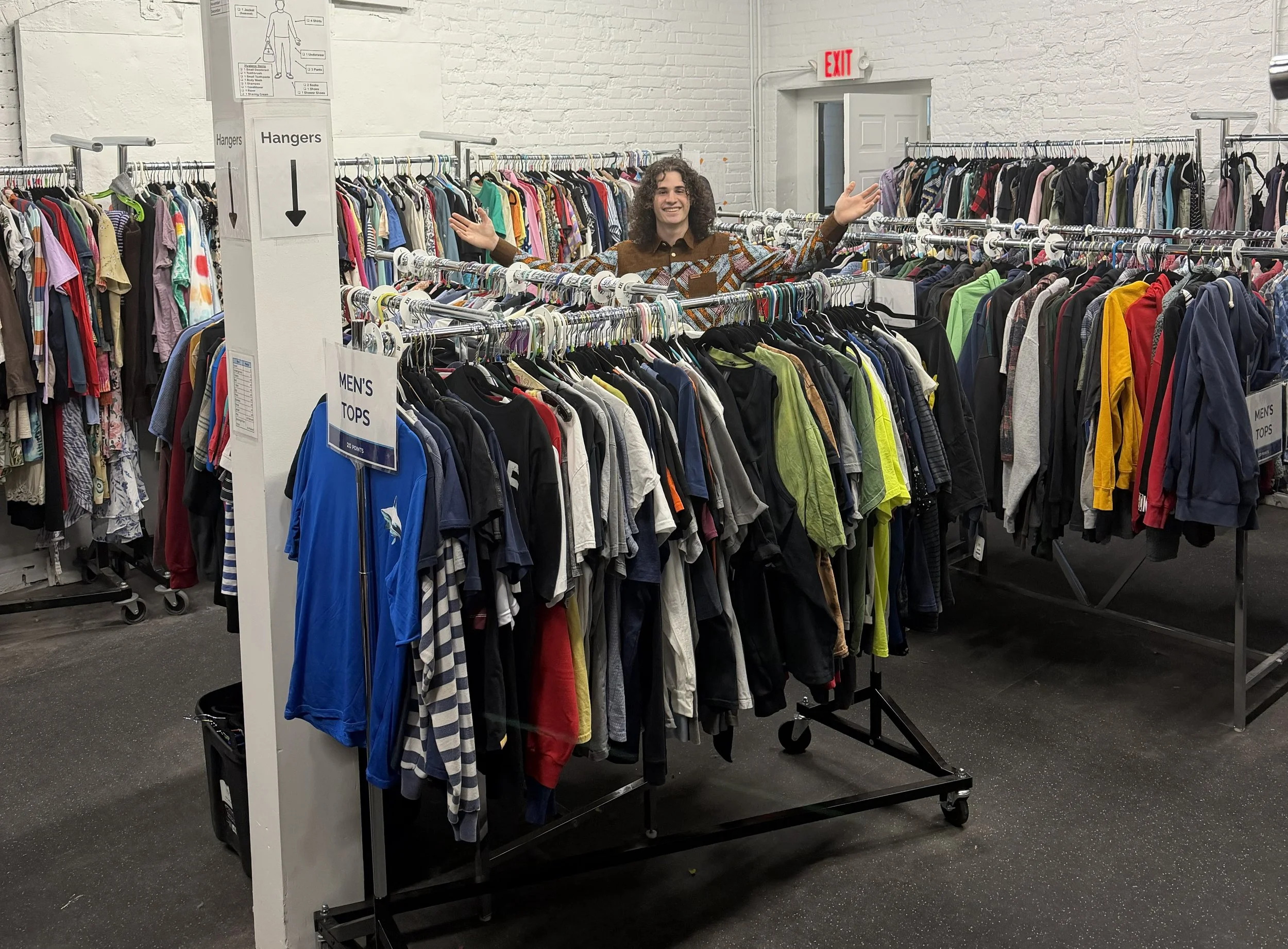
the intern & the donation center
When University of Cincinnati senior Roman Fini introduced himself to staff and clients at Stella Maris this summer, he often described himself as “just an intern.”
He was underselling himself.
Roman is a computer science major eager to find practical ways to use technology for good. For his previous internship, he went to Ghana to develop an algorithm to help rural farmers price their goods more effectively. Unfortunately, because he was part of the first cohort to participate in the three-year research and development program, he wouldn't see the final product.
This year, he wanted a project he could see through to the finish line.
He’s from the area and a 2023 graduate of St. Ignatius (go Wildcats!). With his parents still living locally, the Cleveland Foundation's Internship Program caught his attention.
He reviewed all of the projects offered by participating organizations, and one stood out. Stella Maris opened a new building and wanted to set up a Donation Center for clients in treatment for substance use disorder.
Roman’s curiosity is something that stands out. Even though he didn’t know much about the recovery space, and wouldn’t necessarily be using technology, he felt confident he could deliver results and find fulfillment at the same time.
“It was similar to Ghana in that I gathered data, conducted interviews with people that would be impacted, revised as needed,” he explained. “But here, there was a clear end goal that I would be responsible for achieving. I’d see it all the way through.”
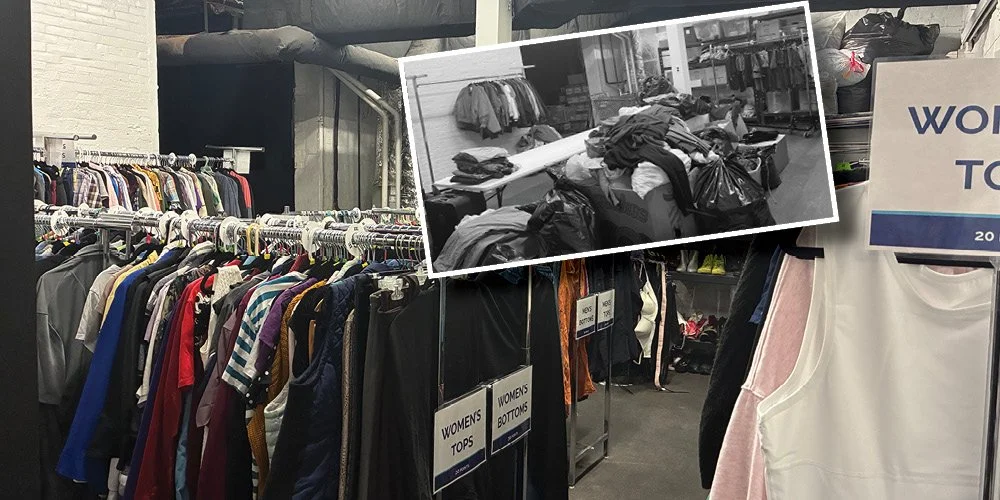
The Donation Center before (inset) and after.
THE ROOM WHERE IT HAPPENS
When Roman arrived, his project was waiting for him—mostly in garbage bags.
The room intended to become Stella Maris' Donation Center was piled with items waiting to be sorted.
Clients often arrive at Stella with little more than the clothes on their backs, creating a constant need for clothing and personal hygiene items. The goal was to create a space where clients could “shop” from racks and shelves rather than rummage through garbage bags. The store-like setting is intended to help them maintain their dignity while going through the recovery process.
Physically setting up the space meant several trips to thrift stores to learn more about tracking and rotating inventory. It also meant
Sorting through hundreds of articles of clothing, removing items that were torn, damaged, or otherwise inappropriate
Running dozens of loads of laundry to freshen items that had been sitting in storage
Sizing, hanging, and displaying the remaining clothing
Not exactly the internship experience portrayed in the movies. But putting together the physical space was just part of the project.
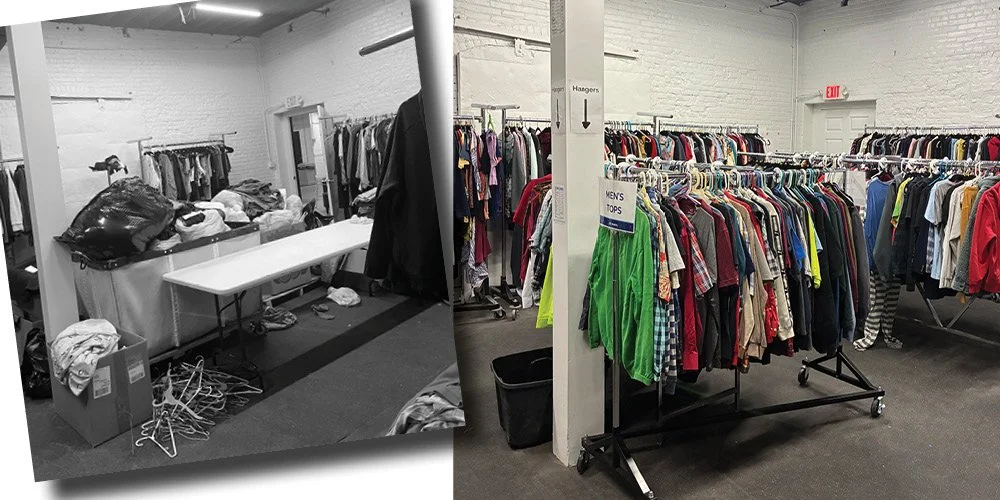
The Donation Center before (left) and after.
THE BRAIN’S REWARD PATHWAYS
The Donation Center needed more than racks, shelves, and neatly folded shirts. It needed a system—one that would give clients an opportunity to earn the items they wanted while reinforcing positive behaviors, also known as contingency management.
Contingency management is an evidence-based approach that uses positive reinforcement to encourage healthy behaviors and support recovery.
“A big part of this for me was understanding the state that clients are in when they live here,” he said. “The program had to meet them where they are, I had to be able to test drive the program with them, and then alter it with their feedback.”
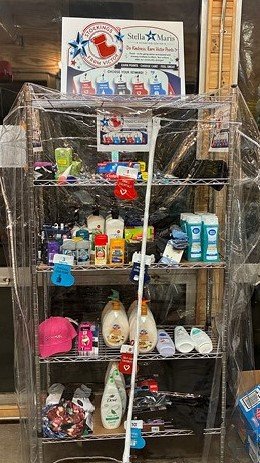
Clients earn Victor Points to shop from the Stockings from Victor shelves.
Roman met with clients in the dorm, convent, and residential program, as well as staff, to find out what kind of tasks could be rewarded with positive reinforcement. After conducting the interviews, he developed weekly checklists that encouraged accountability for everyday responsibilities while giving clients opportunities to earn shopping trips for items they wanted.
While developing his checklists, Roman and his supervisor Tisha Lipscomb were introduced to Kelly Markiewicz, founder of Stockings from Victor. Kelly had lost loved ones to substance use and dedicated her life to providing hope and kindness at Christmas and beyond to people in recovery. Stella clients have received care packages from Stockings from Victor for years.
Kelly had been patiently waiting for Stella’s Donation Center to open so Stockings from Victor could have a permanent presence. With Roman and Tisha, she developed Victor Points, which allow Stella clients to “buy” specialty hygiene and personal care items, products above and beyond what Stella normally stocked from donations. To “buy” these products, clients had to be awarded Victor Points, which could only be earned by going above and beyond, helping someone else. The entire Stella staff was engaged to help award the points when they saw clients doing good deeds.
In the first month, more than 100 Victor Points were given out.
“I was really excited to work with Kelly,” Roman said. “Her program was so similar to what we were developing and it was great to learn more about another nonprofit working in the recovery space. I’m happy with how the partnership turned out and my role in making it happen.”
THE OUTCOMES
“At previous jobs, I was very directed throughout my day-to-day,” he said. “At Stella, I was handed the project and allowed to find the resources I needed to develop the plan and timeline,” he said.
Having ownership made the difference. Tisha provided support, guidance, and assistance as needed, but allowed Roman to take his own approach.
“I can see how the Donation Center directly impacts clients. I can proudly present the Center to them. It’s been so rewarding to see them shop and enjoy the experience and show my work to others,” he said.
“I’ve also been managing the volunteers, which has shown me the other side of the recovery process. Because so many volunteers were related to clients or had relatives who lost their battles, I could see the impact addiction has on families.”
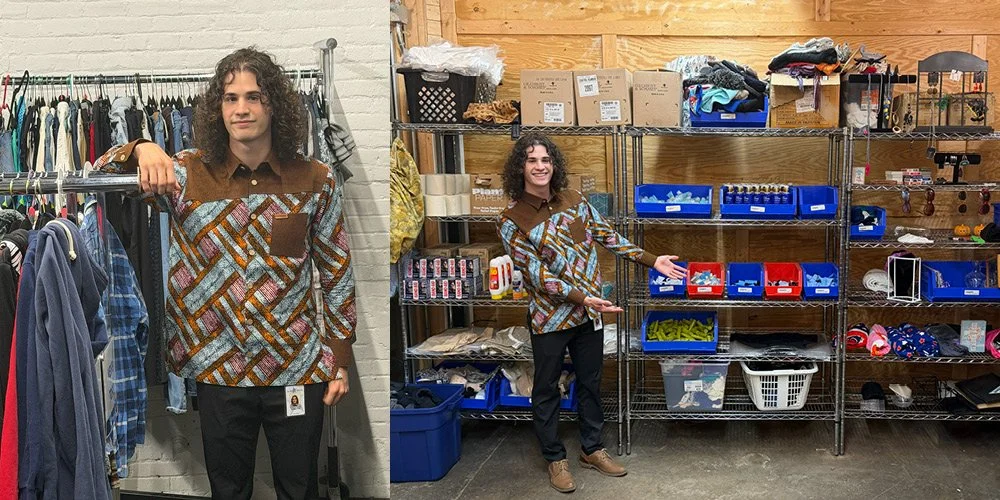
Roman poses wearing as shirt gifted to him in Ghana.
BEYOND COFFEE RUNS
When Roman came to Stella Maris, Tisha was relatively new to Stella, as well. They became a solid team from the very beginning.
“I’m the same age as her son,” Roman said, having celebrated his 21st birthday during his tenure at Stella. “She was one of my biggest influences here. Her own lived experiences really helped me get acclimated and not feel weird about asking questions.”
In fact, Roman said he was surprised by how open the environment is at Stella. “Recovery isn’t something people talk about in my everyday life,” he said. “I was able to learn so quickly because everyone here was willing to share their own experiences. Because I’m young, people were quick to use their experience as... perhaps… cautionary tales for me to reflect on.” His ability to put people at ease made him a favorite around campus.
He was also a favorite among staff. His subtle, quick wit made him a welcome addition to any lunch table—an accomplishment that should not be underappreciated. But more importantly, when Roman didn’t know how to do something, he was confident he could figure it out. Everything was an opportunity to learn. This was the very reason he stayed on for several weeks after his Cleveland Foundation Internship ended.
His work extended far beyond the Donation Center. He sold raffle tickets at Rock of Faith, Stella's musical fundraiser. He created a critically-acclaimed (at least by Stella folks) avant-garde promotional video for Stella's 4th Annual Bike Night—and then rode his own motorcycle to work the event. Sure, he filed papers and carried boxes, as any intern would. But he also filmed nearly 40 interviews for what the Marketing Department referred to only as “a secret documentary.” And he spread awareness about Stella Maris to others who have been fortunate enough to not need the services here. His mother volunteered in the Donation Center and his girlfriend volunteered at two special events.
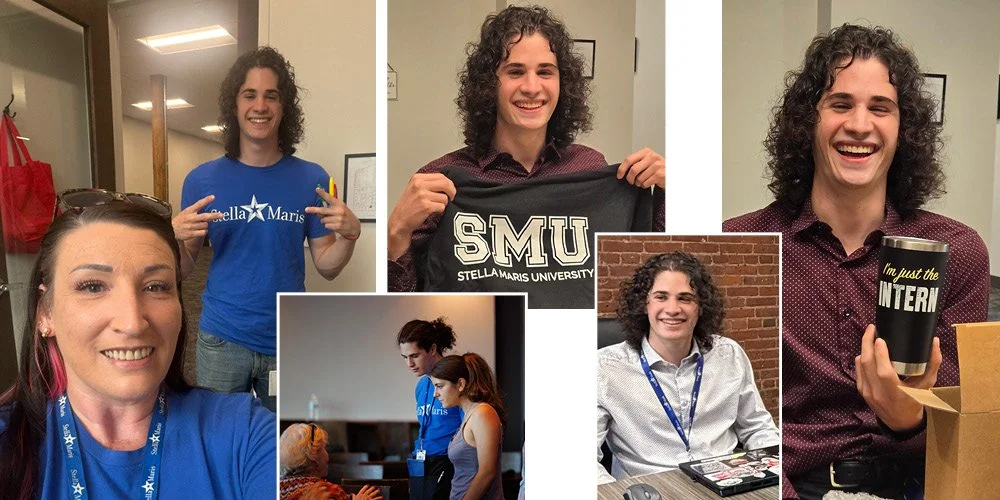
Far left, Roman and his supervisor Tisha twinning. Small left, Roman and his girlfriend speaking with guests at Rock of Faith.
“We had several great candidates from the Cleveland Foundation,” said CEO Christine Robinson. “What made Roman stand out was how he talked about applying his engineering focus to projects that have meaning. I have rarely had someone drop into a project and execute it so completely and effectively. Roman made it happen- and he made it happen with enthusiasm. From day one, he fit right in on the Stella Maris campus. His willingness, spirit, sense of humor, and capability made him a perfect fit . He will be missed!”
By the end of the project, Roman had given multiple presentations about Stella’s Donation Center: to the Cleveland Foundation, Stella’s Board of Directors, and at an All-Staff meeting.
“I was able to watch him grow over the summer in his public speaking abilities. His self-confidence has really blossomed,” Tisha said. “It was a beautiful thing to be part of. I can’t wait to see where life takes him.”
The room that once greeted him with piles of garbage bags is now a place where clients can browse racks, select items they need, and enjoy a more dignified shopping experience.
Roman selected Stella Maris from a group of 21 nonprofits, each with a mission worth supporting. “Looking back, I definitely made the right choice,” he said.
For Stella Maris, the feeling was mutual.
Just an intern? Never.
###
ABOUT THE DONATION CENTER
Stella Maris accepts new or gently used clothing and personal hygiene products for its clients.
To schedule a drop-off or to inquire about volunteering in the Donation Center, contact us at donations@stellamariscleveland.com.
-
New or gently used adult clothing for all genders
Socks and undergarments (new only please)
Jeans, pants and shorts
Shirts, sweatshirts
Winter outerwear - jackets, hats, gloves, boots
Professional attire - skirts, slacks, dresses, suits, dress shirts, neck ties
Shoes - dress, casual, shower shoes, seasonalDescription text goes here
-
New personal hygiene products for all genders
Body wash
Body lotion
Chapstick and lip balms
Deodorant
Dental care products (mouthwash must be alcohol-free)
Hand cream
Shampoo and conditioner
Tampons and sanitary pads